Technology


Bought the subscription model
I’ve always felt more comfortable buying digital goods outright if I wanted them. But lately, I’ve been subscribing to more and more services to get access to content. I think I’m now at the point where I’m close to being fully in the subscription model camp. It’s been a gradual transition. Much like the (fictitious) slowing boiling a frog metaphor I haven’t noticed until it was over.
The transition started with Apple Music. I subscribed to that when it was launched in June 2015. I first used it as a way to get access to new music in high quality from a safe and reputable source. But for a long time, I was still buying any songs or albums that I liked and wanted to have in my iTunes library.
Over the two years since the Apple Music launch, I’ve subscribed to several other services on an annual or monthly fee basis. My subscriptions list at the end of July 2017 now includes:
• Software subscriptions: 1Password, Pocket, Setapp, Office 365, Evernote, Grammarly, Parallels Desktop, FreeAgent, SocialChess, Chess 24, DropBox, iCloud Storage, RescueTime
• Film and TV Subscriptions: Virgin Media TV Large, NowTV, Netflix
• Other: Audible UK, Apple Music
That’s a lot of software service subscriptions. When you list them out, it shows that this is rapidly becoming the new model for digital sales.
I joined NowTV to get access to Sky Atlantic for Twin Peaks The Return. As a bonus, I also got access to Silicon Valley and Veep. Plus Westworld Season 1 will be available from 14th August. So NowTV is a keeper. I subscribed to Netflix to watch The Circle film as it didn’t get a UK cinema release, and I wanted to see it after reading the book. Discovered lots of other good content on Netflix that is well worth the modest monthly fee.
I think that NowTV and Netflix were the services that tipped me over into the subscription model camp. In the last few months, I’ve noticed that I’ve stopped buying albums on the iTunes Store. Rather I just add them to my library from Apple Music. Not sure this is a good thing for the artists. I wonder if the same thing will happen with films over time. I’ve just bought The Ghost in the Shell on iTunes. Will I stop doing that in future and just wait for films to appear on Netflix? Time will tell.
The one product area in which there hasn’t been a viable subscription model for me to adopt is for ebooks to read. I do subscribe to the Audible UK subscription service that gives a single audiobook of my choice per month. For ebooks, the biggest subscription service is Amazon Kindle Unlimited. I’ve looked at it in the past, but it didn’t have many of the books I wanted to read. I must have another look to see how many of the books I’ve read or bought this year are available there.
It’s worth getting an AppleTV just to run Magic Fireplace

You can’t beat a good fire as the nights draw in. Unfortunately I don’t have a good fire. I do however have an AppleTV, an HD television, and a good sound system. So I can have a digital fire. Using the fabulous Magic Fireplace App from Jetson Creative. It displays one of 20 different HD videos of fireplaces. With a pleasing wood burning sounds. Perfect for dark evenings on the sofa with a book and a big mug of tea. Video below.
Outlook cloudy
I used to be an IT infrastructure person. I selected and installed the first Microsoft Exchange mail system in the large company I was working in during the mid 1990’s. I championed and introduced VMware as the virtualisation platform of choice in a different job in the mid 2000’s, before moving on to a technology innovation role to identify and champion new technologies.
If I was working in a company now in an infrastructure role I would have as much as possible of the server infrastructure off premise in the public cloud. I’d only have servers on premise, or in private cloud or a 3rd party data centre, if the data was too sensitive for a public cloud service. And in that scenario I’d adopt a hybrid cloud model with all the data I could have out on public cloud servers, with just the sensitive data on the in house part of the hybrid cloud. The public cloud services I’d use would be Office 365, Microsoft Azure, maybe Igloo for Intranet services, Slack for messaging, and Airwatch for endpoint device management. If any email accounts were mission critical I’d put them on the lowest spec Exchange Server possible in house as part of a hybrid deployment of Office 365.
The IT budget I controlled would be spent on having good redundant Internet connections and giving the users the choice of device they want to use. Be it Mac, Windows PC, iOS or Android tablet, iPhone, or Android phone.
Time for a stupidly big iPhone
Apple hold their annual iPhone event this week. I get a free upgrade on my mobile account on 26th September. I was at the opticians last week. Turns out these three things are actually related.
My optician recommended that I get new varifocal glasses that have a +1 decrease in the prescription strength for viewing things close up. Like an iPhone. I was going to do this. At the very high cost of £595 for the pair of lenses. Advice on Twitter was that varifocals are a pain so I started to have doubts.
iOS on iPhone has a zoomed mode that basically makes everything on the screen bigger. For use in situations exactly like the one I was having to get varifocals for. I have an iPhone 6s now. Apple will release iPhone 7 Plus and probably ship it on 23rd September. I can upgrade just after that. I’m thinking of getting the bigger model and using it in Zoomed mode. It’ll basically show the same amount of stuff on screen as my iPhone 6s in standard mode. But everything will be bigger. And won’t have to hold it at arms length to focus on it!

I’m running my current iPhone in Zoomed mode for the next few weeks as a test. If the rumours about the iPhone 7 Plus are true it’ll also be a bit of a speed demon with a great camera.
Keyboard for use with iPad Pro
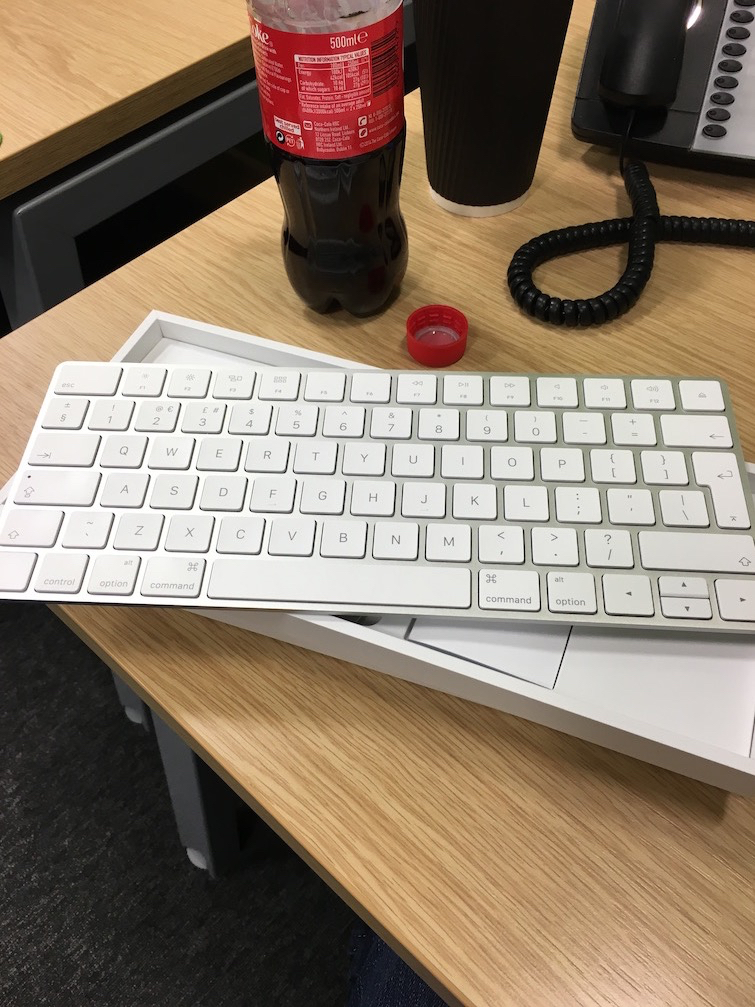
I love my Matias keyboards. But they are too heavy for portable use with iPad Pro. I’m not sold on the Apple Smart Keyboard for iPad Pro. Instead I will get an Apple Magic Keyboard to use with it. It will be cheaper, lighter, won’t drain the iPad Pro battery, and allows the iPad and keyboard to be further apart. Which will be better for getting a good typing position.
And I might get one of these in the future.
Update: Got it. It was the right choice.
Rosenberg’s Law
Rosenberg’s Law: Software is easy to make, except when you want it to do something new. The corollary is, The only software that’s worth making is software that does something new.
Defined by Scott Rosenberg in his book Dreaming In Code.
HDCP Errors with iTunes content on External screens
Edit – I’ll add the pictures bak into this post in a few days.
If you buy or rent films from Apple iTunes in HD format, and then try to play them from a Mac on an external screen, you might get this error:
The selected film won’t play on one of your connected displays.
This film can only be played on displays that support HDCP (High-bandwidth Digital Content Protection).
This is a copyright thing and there doesn’t seem to be a way round it if the Mac thinks your connected display isn’t HDCP compliant.
You can however watch the non-HD version of the film or TV show if you want. Right-click on the film or TV episode in iTunes, and select Video Quality-Standard Definition (SD) from the pop-up menu:
May not be in HD, but useful if you want to watch something from iTunes on an external display.
100 days with Apple Watch
It’s been 100 days since I received my Apple Watch. As I outlined in my previous post I had three main reasons for getting one (beyond being an Apple geek!):
- Be a good timepiece.
- Be a good Activity and health tracker.
- Provide Haptic feedback for directions when walking (as demoed at the Apple launch event).
After 100 days it still fulfils those three functions perfectly. I wear it every day. In fact I feel naked without it. There are other features that I use. These are:
- Haptic notifications for Messages, incoming calls, and calendar events. My iPhone is now on silent all the time. I never miss calls as I get tapped on the wrist when a call comes in. This is awesome.
- Apple Remote app. I can control my AppleTV via the Watch from the sofa. No more groping for the remote.
- Dark Sky app. Given the vagaries of the weather recently it’s great to be able to look at a Glance on my Watch to see if I’m going to be rained on in the next hour.
I bought a black Sports Band to replace the white one it shipped with. Black was what i wanted, but the silver Aluminium Sport didn’t have a combination that included the black band.
Was my Apple Watch worth £339? For me, yes. I’m glad I bought it. I’m still very impressed with it. Looking forward to the next generation of watchOS 2 apps later in the year. They will be faster as they are native, and do not need to rely on a tethered iPhone to function.
My headphones are like new again
I bought a set of Sennheiser PXC 450 headphones in 2007. Love them. They are noise cancelling. When the noise cancelling is on the ambient noise in environment just disappears. Eight years is a long time and I noticed recently that the leatherette covers on the ear pads was deteriorating and starting to flake. So I ordered a new pair of official replacements. They were expensive but well worth it. Came with the fitting rings that hold them on already fitted. So they just snapped on. Now my eight year old headphones are like new again. You get what you pay for!

New ultra beginners books for iOS development
I recently stumbled across a series of beginner books targeted at complete new starters looking to get into iOS app development. The series goes under the name of iOS App Development for Non-Programmers by Kevin McNeish. There are 3 books in the series so far, with more promised. Available on iBooks store, and Amazon Kindle has Book 1. Get the iBooks versions if you have an iPad to read them on. They have embedded videos and tap-through diagrams.
These really are for beginners. Book 1 doesn’t have any coding in it at all. It builds an app in Xcode using standard controls. Even with a map control. The 2nd book is a beginners guide to Objective-C. I like it a lot. The 3rd book is a deeper dive into Xcode. I haven’t read the 3rd book yet. I will soon.
If you are looking to start iOS app development you could do a lot worse than get these 3 books (and the forthcoming ones when available) as a self-teaching course.
When you have read the McNeish books I’d recommend reading the iOS Apprentice. This is another beginners tutorial series. If you tackle it with the McNeish books under your belt you’ll get more from it.
After you have done both the McNeish and the iOS Apprentice tutorials there are lots of more advanced learning resources that will be accessible to you.
Simplified my computer choices
I sold two Apple devices this week. And bought one.
I sold my 4th generation retina iPad. A few weeks ago I decided to use an iPad mini, that I bought as a mobile device management testing device, for a week. Just to get a feel of how the smaller device handled real use. I had voiced the opinion that the lack of a retina screen would mean I wouldn’t like it as much as the larger iPad model. I was wrong. Ever since that week I have hardly used the retina iPad at all. The smaller form factor of the iPad mini gives the full iPad experience in a more portable, and easier to hold, package. The iPad mini may not be a replacement for a laptop, whereas the larger iPad could, and has, for many people. This doesn’t matter to me as I have a 15 inch retina Macbook Pro as my main computing device. If a retina iPad mini ships, and it doesn’t add a lot of weight due to a bigger battery, I’ll get one of those. Or even a 9.7 inch iPad that has the same case style and smaller bezels, like the iPad mini.
I also sold my 16GB iPhone 5. A few times recently I’ve come very close to running out of storage space on my iPhone. I’ve had to choose which podcasts to keep on the phone and also had to delete some multimedia rich apps. I want interesting content, and not storage availability, to be the arbiter of what’s on my iPhone. So I bought a 64Gb iPhone 5 to replace the 16GB one.
So my day to day computing arsenal is now:
- 15 inch retina MacBook Pro.
- 64GB iPhone 5.
- 64GB iPad mini with Logitech Ultrathin Mini keyboard for when required.
I also have the following devices for use in testing mobile OSes and apps outside of iOS, and for mobile device management testing. I don’t use these day to day: